Some cookies used are essential to providing a service, while others help us improve your experience and provide us with insights into how the site is being used.
For more detailed information about the cookies we use, see our Cookies page.
Necessary cookies enable core functionality such as security, network management, and accessibility. You may disable these by changing your browser settings, but this may affect how the website functions.
We'd like to set Google Analytics cookies to help us to improve our website by collecting and reporting information on how you use it. The cookies collect information in a way that does not directly identify anyone. For more information on how these cookies work, please see our 'Cookies page'.
We'd like to allow Social Media cookies to provide a richer experience. These cookies will allow us the ability to list Fife Council tweets and Facebook posts, Google maps, audio clips & Videos on some of our pages. Our videos use Youtube's privacy-enhanced mode.
These cookies allow us to show relevant adverts to the content you are viewing. They also provide the ability to deliver targeted online advertising across other platforms like Facebook, Google, Instagram and the Quantcast network.
Nature networks connect important places for wildlife. This could include nature reserves, restoration sites and other green spaces. Nature networks link these sites together using habitats, wildlife corridors and “stepping stones”. This helps plants and animals to move, adapt and survive.
Nature in Scotland is under pressure. Habitats are being lost or divided, and climate change is making conditions harder for many species to live. Nature networks help to address these challenges by giving wildlife the space and connections it needed to survive.
The aim of nature networks is to build resilience. Resilient ecosystems are able to change and adapt to outside pressures such as disease, drought, pollution or flooding. By identifying, protecting and enhancing nature networks, species are able to move and thrive.
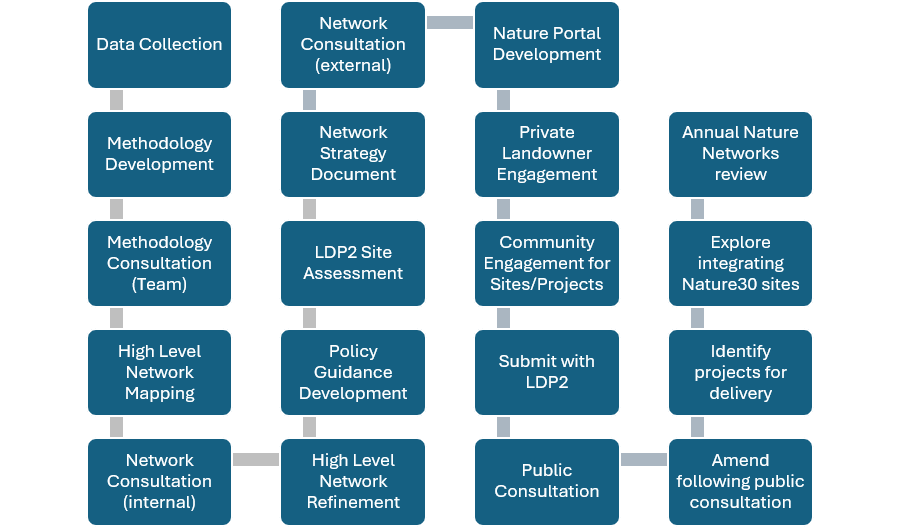
This diagram shows the steps required for the development of Fife's nature networks.
Nature networks not only support wildlife but people too, creating healthier places to live and enjoy. Increasing habitat connections and improving ecosystem health can help to:
Local authorities across Scotland have mapped nature networks with support from NatureScot. This is a live resource that helps public sector organisations to plan and deliver nature networks.
Fife's nature networks connect habitats and protected areas for nature across the Kingdom. Fife has a varied landscape. Home to woodlands, wetlands, a rugged coastline, heathlands such as the Lomond Hills, and grasslands crucial for pollinators. Click below to find out more about each habitat type.
Coastlines, cliffs and sand dunes surround Fife on three sides. They stretch across 170 kilometres and accommodate marine species such as seals and seabirds. Fife's coastal habitats are threatened by climate change. This is resulting in sea-level rise, increased storm frequency and intensity, and coastal erosion. Restoration and protection are key to their resilience.
Grasslands are important habitats for pollinators such as bees and butterflies. They support biodiversity and play a key role in maintaining healthy ecosystems.
Fife's upland habitats, such as bog and heathland, have been shaped by geology and climate for centuries. Bogs are crucial for natural carbon sequestration and storage processes. Heathland areas have become culturally significant in the highest areas of Fife's heartland - the Lomond Hills.
Many burns, streams and rivers start in or pass through Fife. They hold high ecological value, connecting inland areas to the Firth of Forth and Firth of Tay. Watercourses and wetland areas provide key ecosystem services. For example, they buffer against flooding, and support a variety of amphibians, fish and migratory birds.
Woodlands across Fife are a mixture of ancient woodlands and new plantations. Different ages of trees support habitat complexity and are important for supporting a range of mammals, birds and invertebrates. Rare woodland species, such as upland oak woodland and wet woodlands, are protected in several nature conservation areas in Fife. Fife's woodlands also provide recreation opportunities and support community well-being.
Fife's Green and Blue Networks includes woodlands, rivers, wetlands, parks, paths and other natural spaces that help connect people and nature.
The 2023 Audit maps these assets and identifies opportunities to improve them across Fife. This supports the Local Development Plan which outlines the vision for Fife.
To find out more information about you can take a look at our Green and Blue networks in Fife interactive storymap.
We are always interested to hear your thoughts. If you have any feedback on the information on this page, email biodiversity@fife.gov.uk.